Chemical and Process Design Handbook

Invaluable to chemical and environmental engineers as well as process designers, this easy-to-read book shows you how to control chemical processes to yield desired effects efficiently and economically.
 TABLE OF CONTENTS
 Lithopone is a mixed zinc sulfide-barium sulfate brilliant white pigment that contains about 30% zinc sulfide. The original light sensitiveness of this pigment has been mitigated by purification and by the addition of such agents as polythionates and cobalt sulfate.
Lithopone is manufactured by a process (Fig. 1) in which barium sulfide solution is prepared by reducing barite ore (BaSO 4) with carbon and leaching the resulting mass.

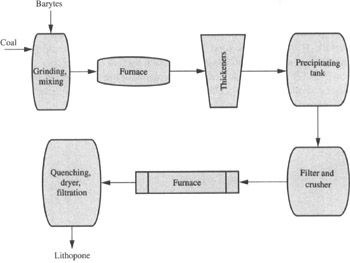
Scrap zinc or concentrated zinc ores are dissolved in sulfuric acid, the solution is purified, and the two solutions are reacted. A heavy mixed precipitate results that is 28 to 30% zinc sulfide and 72 to 70% barium sulfate.

This precipitate is not suitable for a pigment until it is filtered, dried, crushed, heated to a high temperature, and quenched in cold water. The second heating in a muffle furnace at 725 C produces crystals of the right optical size.
Lithopone is used in water-based paints because of its excellent alkali resistance. It is also used as a whitener and reinforcing agent for rubber and as a filler and whitener for paper.
Magnesium occurs in seawater and in ores such as dolomite (CaCO 3 MgCO 3), magnesite (MgCO 3), and carnallite (MgCl 2 KCl 6H 2O).
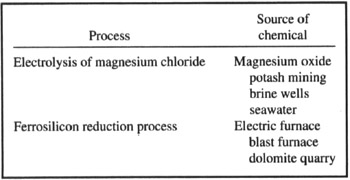
Magnesium can be made by several methods (Fig. 1), but the most common method of manufacture is by the electrolytic process, as for example the electrolysis of magnesium chloride.