Chemical Formulation: An Overview of Surfactant-based Preparations Used in Everyday Life

Waxes have a long history of use in formulations for waterproofing, polishing and cosmetics. These are organic substances from plants, animals or synthetic sources, the latter relying upon petroleum as the raw material. For the most part, the natural ones are long chain fatty acid esters or long chain fatty alcohols. Some notable exceptions are ones such as lanolin. In formulation work, waxes play a major role in the preparation of polishes of which there are three different types: pastes, solvent-based liquids and aqueous emulsions (wax/water and wax/solvent/water).
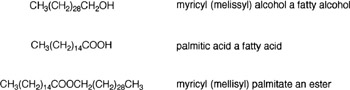
Ever since waxes were first used beeswax has held a position of prominence. It is composed of a mixture of esters such as myricyl palmitate and related compounds all of which have long chain fatty acids/alcohols along with small amounts of hydrocarbons. In common with most natural chemicals it is a complex mixture and is subject to wide compositional variation which depends upon its source.
It has low solubility in most solvents; in turpentine it is about 8% soluble but in white spirit only about 4% will dissolve. The wax is available in several grades depending upon purity and colour. Some of the compounds common to the various grades of beeswax are shown in Figure 1.9.