Chromic Phenomena: Technological Applications of Colour Chemistry
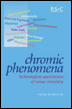
Providing an entry point both for new researchers and for established ones, this book develops and investigates new applications for color chemistry.
 TABLE OF CONTENTS
 Electroluminescence (EL) involves the conversion of electrical energy into non-thermal light. The materials used to achieve this conversion can be either inorganic or organic. Low field devices are the conventional light emitting diodes (LEDs), which are constructed from monocrystalline semi-conducting materials, mostly group III V compounds. Inorganic EL displays are generally high field and are made of insulating materials, where the active material or phosphor is a II VI compound. Organic LEDs are made from either thin films of vapour deposited low molecular weight materials or conjugated polymers put down by spin coating or other means.
Conventional semi-conductor LEDs are made by growing a region of n-type semiconductor material, doped with donors, and p-type semi-conductor material, doped with acceptors, grown as a single crystal. This is shown diagrammatically in Figure 3.26.52 When the material is at equilibrium, the charge in the junction region prevents movement of electrons and holes. By applying a forward bias, or positive charge to the p-type side of the junction electrons are injected into the p-type region and holes into the n-type region, they then combine in the junction region with the majority carriers, leading to emission of light with an energy approximately equal to the band gap. (Note: a material is classified as a semi-conductor when the band gap energy lies in the range of 0.1 6 eV.)

In 1961 it was discovered that gallium arsenide (GaAs)...