Climate Change: A Natural Hazard

This book outlines the continuing need to better understand and predict natural climate variations to underpin better planning, so that the huge annual human and property losses worldwide can be avoided.
 TABLE OF CONTENTS
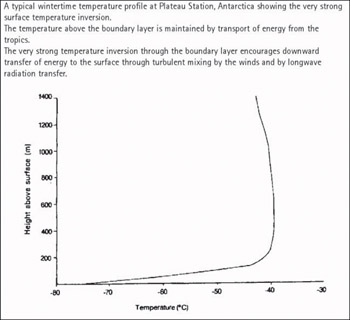
 Surface energy exchanges over polar regions, especially over the extensive snow and icesurfaces of winter are very different to those over the tropics. During the months of the polarwinter there is little or no incoming solar radiation. A characteristic of the boundary layer airis the development of a very strong temperature inversion as shown in Figure13. Instead of the expected decrease of temperature with height there is a very strongincrease of temperature with height in the lowest few hundred metres. This occurs because theatmospheric circulation that transports energy from the tropics tends to maintain the temperatureof the troposphere against radiative cooling. Air over the poles is very dry and, as a consequence,the downward emission of longwave radiation from the atmosphere to the surface is relatively small.The emission of longwave radiation from the surface continues to be relatively strong and there isa cooling of the surface. In the darkness of winter, the surface cools until there is a balancebetween its own longwave emission, the heat conduction from below, and downward longwave radiationemitted from the warmer but dry overlying troposphere.
The contrast between wintertime and summertime surface air temperatures over the Arctic shownin Figure 14is very dramatic. During winter, surface temperatures are well below 0 C over the frozen ArcticOcean and the adjacent sub-Arctic land area. Temperatures are coldest over the high GreenlandPlateau but extremely cold temperatures are also experienced over Siberia and the higher parts ofAlaska.