Colloidal Particles at Liquid Interfaces

Lennart Bergstr m
Department of Physical, Inorganic and Structural Chemistry, Stockholm University, SE-106 91 Stockholm, Sweden
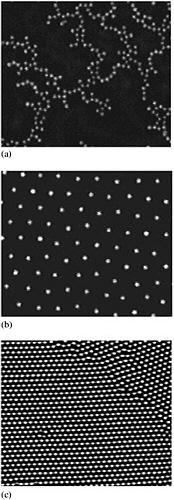
The structure displayed by assemblies of colloidal particles, whether in three dimensions (3-D) or in two dimensions (2-D), is an important aspect in many industrial processes and products, e.g. waste-water treatment, paints and ceramics, but also for the assembly of new materials.1 4 Colloidal particles can be made to organise into ordered arrays or to attain heterogeneous structures with different degrees of disorder. The control of colloidal structure formation starts with the particle interactions (attractive or repulsive) and colloidal dynamics. These interactions balance against thermal forces and external influences such as gravity and applied force fields to determine what configurations the particles will adopt, e.g. network-like, random or ordered configurations (see Figure 2.1).