Colour Chemistry

THE EYE

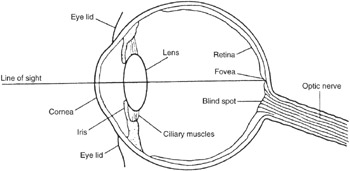
The sensation of colour that we experience arises from the interpretation by the brain of the signals that it receives via the optic nerve from the eye in response to stimulation by light. This section contains a brief description of the components of the eye and an outline of how each of these contributes to the mechanism by which we observe colours. Figure 2.2 shows a cross-section diagram of the eye, indicating some of the more important components.


Figure 2.2: Components of the eye

The eye is enclosed in a white casing known as the sclera, or colloquially as the 'white of the eye'. The retina is the photosensitive component and is located at the rear of the eye. It is here that the image is formed by the focusing system. Light enters the eye through the cornea, a transparent section of the sclera, which is kept moist and free from dust by the tear ducts and by blinking of the eyelids. The light passes through a transparent flexible lens, the shape of which is determined by muscular control, and which acts to form an inverted image on the retina. The light control mechanism involves the iris, an annular shaped opaque layer, the inner diameter of which is controlled by the contraction and expansion of a set of circular and radial muscles. The aperture formed by the iris is termed the pupil. Light passes into the eye through the pupil, which normally appears...

UNLIMITED FREE
ACCESS
TO THE WORLD'S BEST IDEAS

SUBMIT
Already a GlobalSpec user? Log in.

This is embarrasing...

An error occurred while processing the form. Please try again in a few minutes.

Customize Your GlobalSpec Experience

Category: Magnifiers
Finish!
Privacy Policy

This is embarrasing...

An error occurred while processing the form. Please try again in a few minutes.