Colour Chemistry

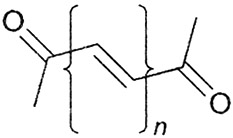
The chemical class of colorants which is second in importance to azo dyes and pigments is characterised by the presence of a carbonyl (C=O) group, which may be regarded as the essential chromophoric unit. The vast majority of carbonyl dyes and pigments contain two or more carbonyl groups which, as illustrated in Figure 4.1, are linked to one another through a conjugated system, frequently an aromatic ring system.
Carbonyl colorants are found in a much wider diversity of structural arrangements than is the case with azo dyes and pigments. By far the most important group of carbonyl dyes and pigments are the anthraquinones, to which a substantial part of this chapter is devoted. Other types which are of commercial importance in particular application classes include indigoids, benzodifuranones, coumarins, naphthalimides, quinacridones, perylenes, perinones and diketopyrrolopyrroles. Carbonyl dyes and pigments are capable of providing a wide range of colours, essentially covering the entire visible spectrum. However, a major reason for the importance of carbonyl colorants is that they are capable of giving long wavelength absorption bands with relatively short conjugated systems. This feature applies especially to anthraquinone and indigo derivatives, which are thus of particular importance in the blue shade area.
In terms of fastness properties, carbonyl dyes and pigments are often superior to their azo counterparts. They are thus commonly the colorants of choice when high technical performance is demanded by a particular application. In most textile dye application classes, carbonyl dyes...