Colour Chemistry

The most obvious requirement of a dye or pigment to be useful in its applications is that it must have an appropriate colour. Of the many ways in which light can interact with objects, the two most important from the point of view of their influence on colour are absorption and scattering. Absorption is the process by which radiant energy is utilised to raise molecules in the object to higher energy states. Scattering is the interaction by which light is re-directed as a result of multiple refractions and reflections. In general, if only absorption is involved when light interacts with an object, then the object will appear transparent as the light that is not absorbed is transmitted through the object. If there are scattering centres present, the object will appear either translucent or opaque, depending on the degree of scattering, as light is reflected back to the observer.
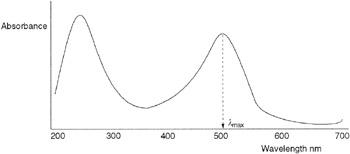
Electronic spectroscopy, often referred to as UV/visible spectroscopy, is a useful instrumental technique for characterising the colours of dyes and pigments. These spectra may be obtained from appropriate samples either in transmission (absorption) or reflection mode. UV/visible absorption spectra of dyes in solution, such as that illustrated in Figure 2.3, provide important information to enable relationships between the colour and the molecular structure of the dyes to be developed.
A dye in solution owes its colour to the selective absorption by dye...