Computational Modeling of Genetic and Biochemical Networks

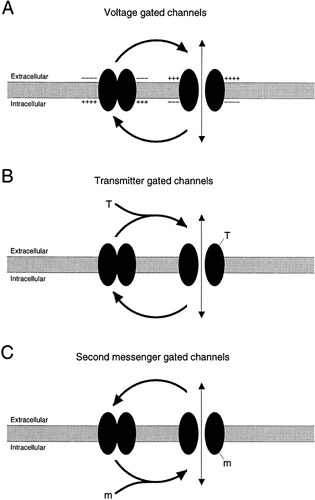
Ion channels are transmembrane proteins containing a pore permeable specifically to one or several ionic species. This property of ionic selectivity is at the basis of the establishment of a voltage difference across the membrane (Hille 1992). This membrane potential is influenced by the opening or closing of ion channels, which can be gated by various factors, such as the membrane potential or the binding of extracellularly or intracellularly released messenger molecules (figure 8.1). In particular, the permeability of some ion channels may depend on voltage (figure 8.1A), which is a fundamental property explaining the electrical excitability of the membrane, as shown by the influential work of Hodgkin and Huxley (1952). Today, several types of voltage-dependent ion channels have been identified and are responsible for a rich repertoire of electrical behavior essential for neuronal function (Llin s 1988).