Computational Science

Illustrating practical examples from computational science, this applications-oriented book teaches students and engineers how to employ mathematical techniques for simulation and data processing using Mathcad.
 TABLE OF CONTENTS
 The special nature of computer data analysis nearly always involves a random factor in one way or another, because any experiment implies errors, noises, and other undesirable data. Therefore, the appropriate computation methods will always be inseparably linked to probability theory and the concepts of mathematical statistics.
We start our discussion of the methods for processing experimental data by classifying the most frequently encountered problems. To this end, we will consider several typical examples, mostly from computational economics and computational geophysics, which we will continue using afterwards.
Fluctuations of financial indicators (for example, currency rates) are an ideal example for studying mathematical statistics.
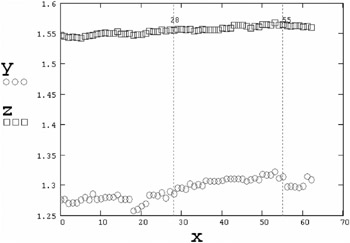
Figure 1.1 shows a graph of changes in the exchange rates of the U.S. dollar and Euro to Swiss Franc (CHF), y and z, respectively, on the FOREX market. Each point on the graph represents the average mean price of the dollar (or euro) on a certain day x. A random date is used as the starting point to track the fluctuations, and the tracking interval, February of 2006, is represented by the dashed lines on the x-axis.
Consequently, the objective of a typical technical analytical study is to select a random process, the time dependence of a certain random quantity, y(x). In practice, the sample is an array of experimental data...