Computer Methods for Ordinary Differential Equations and Differential-Algebraic Equations

Part I: Introduction

Chapter List

Chapter 1: Ordinary Differential Equations

Overview

Ordinary differential equations (ODEs) arise in many instances when using mathematical modeling techniques for describing phenomena in science, engineering, economics, etc. In most cases the model is too complex to allow one to find an exact solution or even an approximate solution by hand: an efficient, reliable computer simulation is required.

Mathematically, and computationally, a first cut at classifying ODE problems is with respect to the additional or side conditions associated with them. To see why, let us look at a simple example. Consider

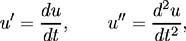
where t is the independent variable (it is often, but not always, convenient to think of t as "time"), and u = u( t) is the unknown, dependent variable. Throughout this book we use the notation

etc. We shall often omit explicitly writing the dependence of u on t.

The general solution of the ODE for u depends on two parameters ? and ?,

We can therefore impose two side conditions.

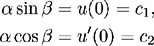
  • Initial value problem (IVP): Given values u(0) = c 1 and u ?(0) = c 2, the pair of equations

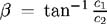
    can always be solved uniquely for and (or ; at least one of these is well defined). The IVP has a unique solution for any initial data c = ( c 1, c 2) T. Such solution curves are plotted for c 1 = 1...

UNLIMITED FREE
ACCESS
TO THE WORLD'S BEST IDEAS

SUBMIT
Already a GlobalSpec user? Log in.

This is embarrasing...

An error occurred while processing the form. Please try again in a few minutes.

Customize Your GlobalSpec Experience

Category: Heat Exchangers
Finish!
Privacy Policy

This is embarrasing...

An error occurred while processing the form. Please try again in a few minutes.