Computer Methods for Ordinary Differential Equations and Differential-Algebraic Equations

In this chapter we consider another group of methods extending the basic methods of Chapter 3 to higher order; see Figure 4.1 The methods considered here use information from previous integration steps to construct higher-order approximations in a simple fashion. Compared to the Runge Kutta methods of the previous chapter the methods here typically require fewer function evaluations per step, and they allow a simpler, more streamlined method design, at least from the point of view of order and error estimate. On the other hand, the associated overhead is higher as well, e.g., when wanting to change the step size, and some of the flexibility of one-step methods is lost.
For our prototype ordinary differential equation (ODE) system
it is customary to denote
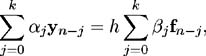
where y l is the approximate solution at t = t l. The general form of a k-step linear multistep method is given by

where ? j, ? j are the method's coefficients. We will assume that ? 0 ? 0, and ? k + ? k ? 0. To eliminate arbitrary scaling, we set ? 0 = 1. The linear multistep method is explicit if ? 0 = 0 and implicit otherwise. Note that the past k integration steps are assumed to be equally spaced.
Throughout most of this chapter we again consider a scalar ODE
to simplify the notation. The extension to ODE systems is straightforward unless...