Computer Methods for Ordinary Differential Equations and Differential-Algebraic Equations

Chapter 4: One-Step Methods

Overview

The basic methods developed in Chapter 3 can be adequate for computing approximate solutions of a relatively low accuracy (as we will see, for instance, in Example 4.1) or if the problem being solved is rough in a certain sense (see Section 3.7). But often in practice a quality solution of high accuracy to a relatively smooth problem is sought, and then using a basic, low-order method necessitates taking very small steps in the discretization. This makes the integration process inefficient. Substantially fewer steps are needed when using a higher-order method in such circumstances.

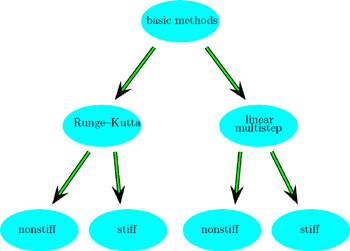
In order to develop efficient, highly accurate approximation algorithms, we therefore design higher-order difference methods. The higher-order methods we consider in this book are of two types: one step and linear multistep. In each of these classes of methods it will be useful to distinguish further between methods for stiff problems and methods for nonstiff problems. The big picture is depicted in Figure 4.1.


Figure 4.1: Classes of higher-order methods.

In this chapter we will explore higher-order one-step methods. These are methods which do not use any information from previous steps (in contrast to linear multistep methods, which will be taken up in the next chapter). Thus, in a typical step of size h = h n = t n ? t n ?1, we seek an approximation y n to y( t n) given the previous step's end result, y n ?1.

Taylor...

UNLIMITED FREE
ACCESS
TO THE WORLD'S BEST IDEAS

SUBMIT
Already a GlobalSpec user? Log in.

This is embarrasing...

An error occurred while processing the form. Please try again in a few minutes.

Customize Your GlobalSpec Experience

Category: Automated Test Equipment
Finish!
Privacy Policy

This is embarrasing...

An error occurred while processing the form. Please try again in a few minutes.