Cool Thermodynamics: The Engineering and Physics of Predictive, Diagnostic and Optimization Methods for Cooling Systems

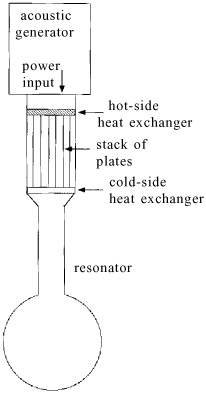
In thermoacoustic refrigeration, high-intensity sound waves are used instead of compressors to set up a standing wave in a closed resonator tube filled with inert gases, and in which a stack of plates is inserted with heat exchangers at its ends [Swift 1988; Garrett & Hofler 1992] (see Figure 2.24). The gas is compressed by the acoustic standing wave, warms up, and transfers heat to the stack plates. The temperature difference that develops along the stack plates is called the thermoacoustic effect. A heat exchanger rejects part of this heat, and the remaining cooled gas is used to chill the load via the other heat exchanger. The process is cyclic.
The basic but involved physics and thermodynamics underlying thermoacoustic processes are already well understood [Wetzel & Herman 1997]. The two predominant irreversibilities are viscous dissipation in the working fluid, and finite-rate heat transfer at the heat exchangers.
The most notable use of the thermoacoustic refrigerator to date has been as a cryocooler in satellites [Garrett & Hofler 1992], where using low input power and having large temperature spans (100 200 K) are critical (in contrast, for example, to commercial mechanical chillers which have far higher input power and far smaller temperature spans). We'll return to the thermoacoustic chiller in Chapter 10 to examine how its performance data compare with the universal aspects of the chiller models that will be developed in the ensuing chapters.