Cool Thermodynamics: The Engineering and Physics of Predictive, Diagnostic and Optimization Methods for Cooling Systems

"A child of five would understand this. Send somebody to fetch a child of five."
- Groucho Marx
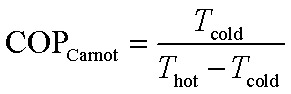
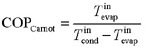
The simplest and most basic limit to chiller thermodynamic performance is the upper bound on COP that follows from the Second Law (Equation (2.5)). Between the reversible limit
| (4.1) | |
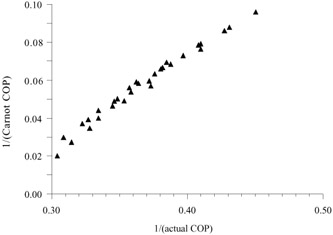
and the actual COP of real chillers lies a sea of irreversibilities. These dissipative mechanisms turn out to be so great (at least with technologies developed to date) that in reality the COPs of commercial chillers rarely exceed half of the reversible limit of Equation (4.1). Small reciprocating chillers realize far smaller fractions of the Carnot COP. As a quantitative example, we offer in Figure 4.1 performance data from a relatively efficient commercial reciprocating chiller. The ratio of actual to Carnot COP varies from 0.07 to 0.21, depending on operating conditions ( i.e., depending on coolant temperatures and cooling rate). From experimental measurements of chiller performance in manufacturer catalogs, from several of the references cited in this book and from actual chiller data reported directly here, the reader can confirm that these low fractions of COP Carnot are typical of commercial chillers.
Entropy...