Countersinking Handbook

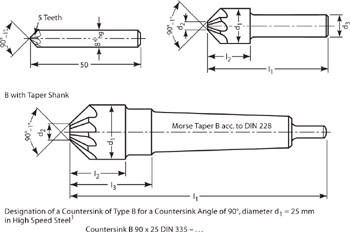
The German institute Deutsches Institut f r Normung e.V. (DIN) develops standards for German industry. It has four countersink standards, which are mentioned here and in later sections. Its practice is to designate countersinks by countersink angle rather than style of tool. For example, the title of DIN 334 is Countersinks with 60 Angle (Anonymous 1962a). DIN 335 covers 90 angles (Anonymous 1962d), DIN 1863 covers 75 tools (Anonymous 1962b) and DIN 347 is for 120 angles (Anonymous 1962c). DIN 333 covers 60 center drills (Anonymous 1962e). An additional series of standards for countersinks issued in 2006 is shown below.
DIN 1863 Countersinks for Countersunk Head Rivets
DIN 1866 90 Countersinks with Parallel Shank and Solid Pilot
DIN 1867 90 Countersinks with Morse Taper Shank and Detachable Pilot
DIN 1868 Detachable Pilots for Counterbores and Countersinks
As Fig. 3-5 shows, the number of a cutter's flutes or teeth is not a major consideration for some items listed in the DIN standards. In the present handbook the author segregates cutters by basic design concepts, then by number of flutes if appropriate (number of teeth for rotary burs is generally not a major consideration; i.e., one would not expect the difference between 23 vs. 24 teeth to affect the resulting cut significantly).
The DIN standards define tolerances for key features of countersinks. Also note in the DIN illustrations that the standard explicitly defines the truncated diameter at...