Countersinking Handbook

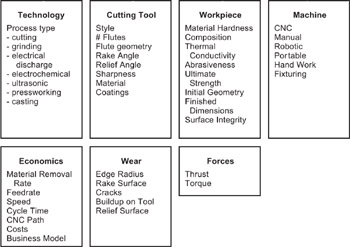
Fig. 6-1 illustrates the principle variables in countersinking operations. While most users think of the operation as using cutters, many non-cutting tool manufacturing operations produce countersinks. This chapter will concentrate only on mechanical cutting, but Chapters 12 and 13 will discuss other processes for countersinking. The many different styles of cutters as shown in Chapter 3 document the challenge users have in assuring they have the lowest cost tool. Tool life, original tool cost, labor, equipment costs, available equipment, finished part requirements, initial part configuration, and workpiece properties all influence the economics of an operation.
Table 6-1 provides a summary of applications for the many designs shown in Chapter 3. The table is not complete and in many instances there is no published data documenting the advantage of one tool over another. Some are simply more convenient to use. Some are less expensive to purchase. Some are only suited for manual work while others are only suited for machine tool applications.
| Style # | Application | Comment |
|---|---|---|
| 1 | Single-flute designs are general use tools suitable for deburring, countersinking, and chamfering. As is mentioned later they are useful for preventing chatter, for portable and machine work at high speeds. | Will countersink smaller holes than multi-flute tools. One source indicates the diameter of the drilled hole should be at least 10% of the diameter of the countersink. They are used with light duty portable applications... |