Countersinking Handbook

A few configurations are unusual, used in only a single application or while not applicable today are interesting to note for historical reasons. Some of these are described below.
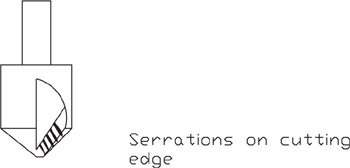
Some of the fiber filled abrasive composites were originally machined using countersinks having serrations cut in the cutting lips as shown in Fig. 3-174. Serrations can be cut into almost all of the tools shown in this chapter.
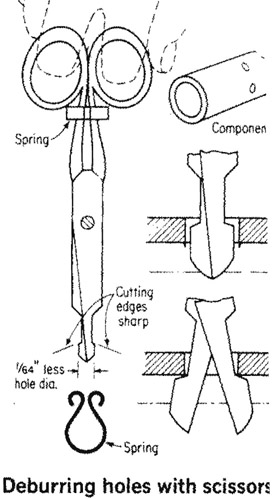
One enterprising machinist solved a deburring problem by modifying a pair of scissors as shown in Fig. 3-175. The tubular part had crosss holes that needed deburring on the inside of the holes. The ID of the tube was 3/4. and would not allow typical shop tools to be effective. The tips of the scissors were ground to fit through the ehole and then notched as shown. A loop spring near the handle kept the blades in the open position (Amalore 1973). This was not a particularly good solution but it did allow immediate finishing of the holes that were on hand.
Fig. 3-176 illustrates a round carbide blank modified to make a simple chamfering tool. A suitable angle is ground on one end of a split carbide blank. Sufficient side relief is ground to prevent the tool from rubbing. It...