Critical Chain Project Management, Second Edition

This book approaches the problem of improving project management from the perspective of synthesizing two domains of knowledge: the PMBOK [1] and the TOC. We consider this synthesis with perspectives from two other knowledge areas: Lean Manufacturing and Six Sigma. This chapter addresses each of these knowledge areas in order and illustrates their relationship to the overall CCPM approach.
These knowledge areas provide different reality filters, or paradigms, to under- stand the project system. Multiple perspectives enable deeper understanding of the theory underlying CCPM, which I define as the synthesis of Dr. Eliyahu Goldratt s critical-chain approach to schedules and the rest of the PMBOK . The underlying theory enables you to deal with issues unique to your environment or project.
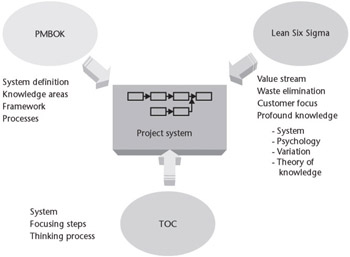
Figure 2.1 illustrates how the multiple perspectives on the project system might look at problems in project performance. The PMBOK perspective compares actual project system performance to the PMBOK model, which it assumes to be correct. Therefore, the PMBOK perspective is unlikely to blame elements of the PMBOK project system as the cause of the problems. It is much more likely to blame performance problems on failure to execute properly the (assumed) effective system. This is indeed the nature of much of the project-management literature, as described above. Dr. W. Edwards Deming has noted that you should not expect significant system changes to come from within the system. A natural consequence of solutions based on the PMBOK perspective is to do more better.