Critical Chain Project Management, Second Edition

Deming, the man whom most people consider the father of TQM, never defined it. Deming described his approach in seminars and books [12, 13] and, although he was a great advocate of operational definitions, chose never to offer one for TQM. Instead, he preferred to discuss the matter in terms of his fourteen points, or Principles for the Transformation of Western Management. He supplemented these points with identified diseases and obstacles to achieving the transformation he preached.
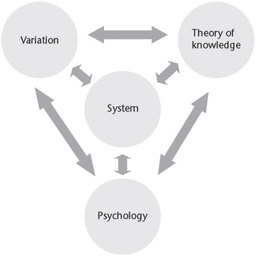
In later life, Deming brought together the overall methods he believed in under the title of a System of Profound Knowledge [13], which he defined as a lens and map of the theory to understand and optimize organizations. He emphasized that profound knowledge is itself a system, having an aim and with all of its parts inter- connected. He identified four segments for discussion but emphasized that they cannot be separated:
Appreciation for a system;
Knowledge about variation;
Theory of knowledge;
Psychology.
Figure 2.3 illustrates the interrelationship of the four elements. The following relates the elements to the project-management system.
Every system must have a defined aim or goal. That is the purpose of the system and defines the boundary of the system. The systems itself is a network of interdependent components that work together to try to accomplish the aim of the system. Profit-making business systems have a goal to make money,...