Digital Communication Systems Using SystemVue
Binary amplitude shift keying (ASK) keys the carrier frequency as one of two discrete levels during the bit time T b for the representation of binary logic signals for the transmission of information. A convenient set of amplitudes for binary ASK is 1 V for binary 1 and 0 V for binary 0, which is also known as on-off keying (OOK). The modulated sinusoidal carrier signal has an amplitude of A V, a carrier frequency of f c Hz, and a 0 reference phase angle, as given by the analytical expression in Equation 3.14.
| (3.14) | |
The information signal or data source is m j( t) ( j = 0, 1) and for on-off keying m j( t) = 0 V or 1 V for one bit time T b.
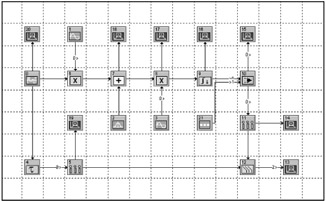
On the CD A binary amplitude shift keying (ASK) coherent digital communication system with AWGN is shown in Figure 3.4 (see Fig3-4.svu on the CD-ROM). To facilitate the simulation in SystemVue, all of the Analysis tokens, except that for the BER token output as the Final Value token, are deleted in the simulation model Fig3-4DT. As described in Chapter 1, "Communication Simulation Techniques," the SystemVue Textbook Edition does not permit tokens to be deleted.
The data source is the polar pseudonoise PN Sequence token from the Source Library, with...