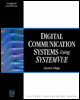
Digital Communication Systems Using SystemVue
Analog sources of information are often derived from transducers that provide continuous electrical (usually) voltage signals from physical phenomenon such as light, pressure, temperature, vibration, and acceleration. These analog baseband signals are bandlimited to a maximum frequency. Analog bandpass signals are modulated sources of information that are transmitted on a communication channel, and are substantially higher in frequency. Both analog baseband and bandpass signals are continuous in time and amplitude, and are sampled and quantized for digital signal processing.
Analog signals are first sampled at discrete intervals of time, but continuous in amplitude. Quantization then is the roundoff of the continuous amplitude sample to a discrete preset value, represented as a binary number or binary bit pattern. The preset values are equally spaced in uniform quantization, and the total number of binary bits is the resolution. In nonuniform quantization, the preset values are not equally spaced, and the resolution varies.
nonuniform quantization is often used to improve the perceived quality of a sampled speech, where nonlinear compression is used at the transmitter, and nonlinear expansion is used at the receiver. The procedure for nonlinear compressing and expanding of a signal is referred to as companding.
Pulse code modulation (PCM) represents the sampled and quantized analog baseband signal as a sequence of encoded pulses. The PCM receiver regenerates, decodes, and reconstructs the sequence of quantized samples of the original analog signal. The line codes used here for the baseband signals are an...