Digital Communications: Microwave Applications

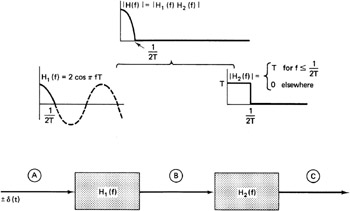
First, we discuss the duobinary technique. Consider a binary input train consisting of 1 s and 0 s represented by impulses + ?(t) or ? ?(t), as shown at A in Fig. 7.1. For each ?(t) input at A , the output at B is [ ?(t)+ ?(t ?T)] with the appropriate sign. We define the impulse response of H 1 (f) as h 1 (t):
where
is the Fourier transform, and h 1 (t) the impulse response. Also,
=speed in b\s
T=bit interval in seconds
Since
, then
To limit the bandwidth, we place the Nyquist rectangular filter H 2 (f) after H 1 (f), as shown in Figure 7.1, and specify H 2 (f) by the following equation: H 2 (f)= T for f ?1/2 T and zero elsewhere. The overall transfer function from A to C in Fig. 7.1 represents the duobinary conversion filter H(f) and is given by:
and zero elsewhere.
The impulse response of H(f) is obtained from equation (7.2), and is
Hence, for every input impulse ?(t) at A, the output at C is h(t), with an appropriate polarity. Since the bit interval is T seconds, there will be overlap or ISI between the digits over...