Digital Communications: Microwave Applications

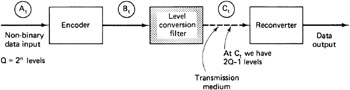
The correlative concept can be extended from binary to multi-level zero-memory non-binary signals [7.9]. The binary baseband correlative system, such as the duobinary and the modified duobinary, have a logical extension to non-binary waveforms where the input pulse train has Q levels and Q=2 n, ( n being an integer greater than unity). The basic block diagram of a non-binary correlative system is similar to that of the duobinary (Fig. 7.8), except that at A t the data input is not binary but has Q levels. A block diagram of such a system is depicted in Fig. 7.12.
At A t the data input appears in a non-binary form and has 2 n levels. The symbols are uncorrelated, and each represents two or more binary digits. The coder converts the Q-level input, consisting of independent digits, into a Q-level source with a memory extending over a fixed number of digits. Next, the level conversion is accomplished by using a level conversion filter. Such a filter causes overlap of pulses and introduces a controlled amount of intersymbol interference. As a consequence, the number of levels at C t is 2 Q ?1. Correlation properties are inherent in such a waveform. Nevertheless, it is possible to associate each level with the non-binary digit input at A t. At the receiving end, the reconverter recon...