Digital Communications: Microwave Applications

Another advantage of correlative systems compared to zero-memory systems is their error-detection capability [7.11, 7.12]. Error detection in zero-memory systems requires redundancy. Correlative systems, however, have finite memory, and this memory can be utilized to monitor and detect errors without introducing redundant digits at the transmitter.
Distinctive patterns exist in the (1+ ?) or (1 ? ? 2) correlative waveforms.
The duobinary (1+ ?) system has three levels: top and bottom (referred to as extreme levels) and a center level. These patterns follow the unique rule: The polarities of two successive bits at the extreme levels are opposite if the number of intervening bits at the center level is odd. Otherwise, they have the same polarity.
The modified duobinary system (1 ? ? 2) also has three levels. The pulse train is divided into odd and even bits. Both odd and even pulse trains follow the same patterns. The rule for odd as well as even bits is as follows: Two successive bits at the extreme levels always have opposite polarity. This phenomenon is indicated below, in sequence C t for the even bits.
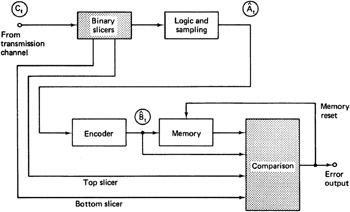
Any time the above rules are violated, errors result that can readily be detected. The generalized diagram for the error-detection process [7.9] for binary and non-binary signals is shown in Fig. 7.17.