Digital Filter Design Solutions

This chapter gives the filter coefficients and characteristics of a selection of high-pass filters that are available in this offering. It is identical in format to those given in the last chapter on low-pass filters with some exceptions that are highlighted below.
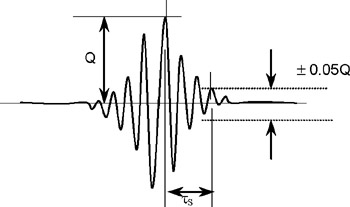
The parameters given in the Performance Features table have the same meaning as before. However, note that since high-pass filters do not support the DC component in a given signal, the step response returns to zero after some oscillations. Moreover, the step response is with reference to unit step input, and as such the overshoot Q is given as a percentage of the input. For example, if a 2V step input is fed into the filter HPF99F0.175, the output peak response would attain 41% of 2V = 0.82V before settling down to less than 41mV (i.e., 5% of 0.82V) in 12 sampling periods. Note too that there is no rise time ? R in comparison to its low-pass counterpart since there is no apparent step on the output. Figure 4.1 shows the relationship between the overshoot Q and settling time ? S for the high pass filter.
The conversion formula from floating-point precision to B-bit word representation is
Here h k,B is the new B-bit representation of the filter coefficient h k, ROUND(