Digital Filter Design Solutions

The ideal differentiator D(F)is characterized by a linear transfer function in the frequency domain, and like all FIR filters, can be designed with either even or odd filter order. Its magnitude D (F) is perhaps best represented by
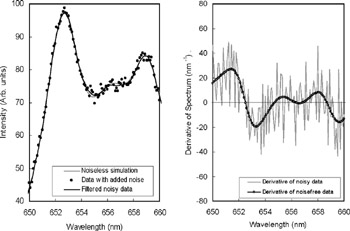
where F is the normalized frequency. It is clear from 6.1 that unlike non-differentiating digital filters, the magnitude of the differentiator increases linearly in frequency, suggesting some form of amplification across its passband. When the input signal to the ideal differentiator is noiseless, it becomes apparent that the digital differentiator performs perfect differentiation. However, if white noise is added to the signal, the high-frequency components of the noise are nonlinearly amplified across the Nyquist range leading to gross distortion of the differentiated output. As such, full band differentiators are inherently noisy. To illustrate this point, Figure 6.1 shows the derivative of a signal without and with a small amount of added noise. Although the signal-to-noise ratio (SNR) of the input signal is relatively high, the SNR of the output is markedly poor.
Some effort has been expended in developing digital differentiators that avoid or reduce the deleterious effects of the non-linear amplification process. For example,...