Digital Signal Processing Fundamentals

THE CONVOLUTION PROCESS

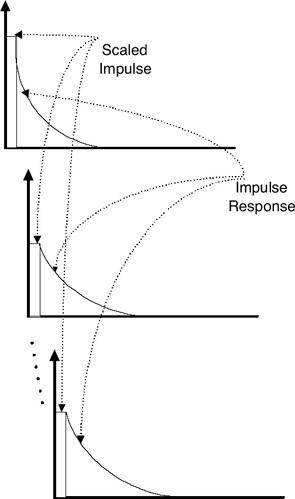
The first step in convolution is to isolate the impulse from the rest of the input and then scale it. This creates a trail of unit impulse scaled by the input signals at specific instance of time, as shown in Figure 4.9. Without making it sound too complicated, if you think about it, the whole process is akin to simply taking the instantaneous values of the input signal at a specific interval of time. The value being acquired is the scaled unit impulse value, but of course delayed by the sampling interval. In this scheme, each new response will have a contribution from the previous response that we must take into consideration into the current output.


Figure 4.9: Input sliced into a series of impulse and response.

Discrete Time Convolution

Mathematically, we can express the operation of discrete time sampling as shown in Figure 4.9. A trail of areas delayed by the interval ? t. If t and i s( t) are the instantaneous sample time and sample value and t n and h( t n) are the n th sample time and unit impulse response, then the n th delayed response is i s( t n) h( t ? t n) ? t. The one before that is i s( t n ?1) h( t ? t n ?1) ? t, all the way to the beginning

UNLIMITED FREE
ACCESS
TO THE WORLD'S BEST IDEAS

SUBMIT
Already a GlobalSpec user? Log in.

This is embarrasing...

An error occurred while processing the form. Please try again in a few minutes.

Customize Your GlobalSpec Experience

Category: Data Input Modules
Finish!
Privacy Policy

This is embarrasing...

An error occurred while processing the form. Please try again in a few minutes.