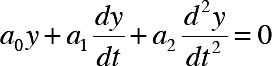
This is the response due to the internal stored energy only. There is no external input force, making x(t) equal to zero. Thus, Equation 4.18 becomes,
Let's work through an example to find the solution, as we did with the first order differential equation. We will go through the series as well as parallel combination of RLC network simultaneously. The circuit of Figure 4.12 is a network of a resistor, capacitor, and an inductor ( RLC) in series and Figure 4.13 is the network in parallel. In both cases, the capacitor was charged initially with the voltage V 0, before being switched to the network.
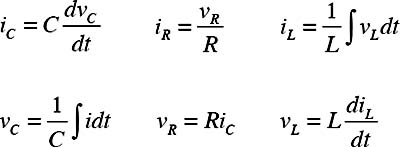
Following are the relationships between the current and voltages across different elements in the circuit.
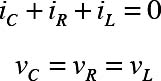
At the time, the switch was thrown toward the capacitor. Kirchoff's current and voltage law describes the relationship for the parallel network as
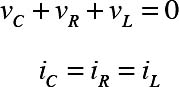
and for the series network as
We get a second order differential equation as a result of summing the current in case of the parallel network, resulting in the following homogenous Equation 4.19.
Substituting the value of  and
and  in Equation 4.19, we get Equation 4.20.
In case of the series network, summing the voltage provides Equation 4.21.
Taking the derivative of Equation 4.21, we get Equation 4.22.
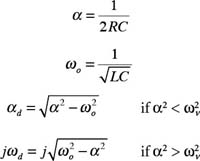
Let's define the following terms.
For series network,
And for parallel network,
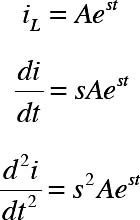
Assuming the current i as an exponential function of time,
Substituting these expressions into the homogenous solution of Equations...


 TABLE OF CONTENTS