Digital Signal Processing Fundamentals

Energy storage elements produce frequency response that acts as filters, and we have seen in the analog filters how different combination of resistors, capacitors, and op-amps exhibit the filter action. The same effect can be achieved using computers in the form of digital filters, but there is much more to it than just following the analog response. Some of the techniques in the digital filters have no parallel in the analog design, such as the sampled data processing of averaging and windowing that is only possible in the digital domain. Although the digital filters are diversified in nature, from the control system point of view, replacing the analog filters with the counter part digital filters is an important consideration in any system design.
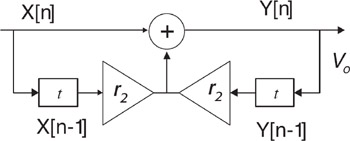
A filter is generated when a delayed input and or output is fed back to the system after being multiplied by a complex quantity (see Figure 7.1). The complex quantity multiplier forms the Transfer Function of the system, and how to formulize it is the topic of discussion in this chapter.
The analog filters of the previous chapter produced the frequency response through implementing a Transfer Function, whose coefficient values matched the component values. But the digital filters will be implemented...