Distillation Theory and its Application to Optimal Design of Separation Units

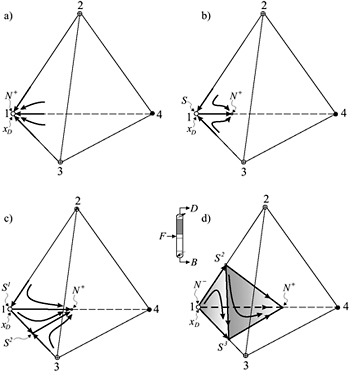
General regularities of the evolutions of sections trajectory bundles, discussed in the previous section for three-component mixtures, are valid also for the mixtures with bugger number of components. Figure 5.23 shows evolution of top section trajectory bundle at separation of four-component ideal mixture, when the product is pure component (i.e., at direct split) ( K 1 > K 2 > K 3 > K 4, x D 1 = 1). At the increase of the parameter L/ V, vertex 1 turns from stable node N + (Fig. 5.23a) into the saddle with two going in and one going out trajectories S (Fig. 5.23b), then it turns into the saddle with one going in and two going out trajectories S 1 (Fig. 5.23c) and, finally, it turns into the unstable node N ? (Fig. 5.23d). After that, three-dimensional section region
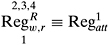
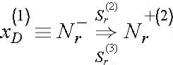
that increase at the increase of the parameter L/ V appears. Stationary points S 2, S 3, and N + ( S 1 ? N ?) move along the edges of concentration tetrahedron. The section trajectory bundle may be presented in the following brief form (the bundle s direction is indicated by the double arrow, its stationary points around it):