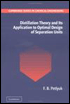
Distillation Theory and its Application to Optimal Design of Separation Units
5.8. Conclusion

5.8. Conclusion

At sharp distillation with finite reflux, the product points should belong to possible product regions and at those boundary elements of concentration simplex at which trajectory tear-off regions and are available. In the tear-off points equilibrium coefficients of absent components j should be smaller (bigger) than those of present components i in the top (bottom) section ( K ri > K rj, K si < K sj). Section trajectories tear off from the boundary elements at the value of the parameter L/ V greater than the values of phase equilibrium coefficients of the absent components ( L/ V > K j) in tear-off point x t.

In the mode of minimum reflux, R min at sharp distillation without distributed components trajectory of the top (bottom) section goes from the product point x D ( x B) to the trajectory tear-off point ( ) into the boundary element, containing one additional component referring to product components, that is the closest one by phase equilibrium coefficient, then it goes from point ( ) to the point of trajectory tear-off ( ) inside concentration simplex, then it goes from point ( ) to point x f ? 1 ( x f) in the feed cross-section of the column. Along with that, material balance should be valid in the feed cross-section.

Separatrix sharp region of the section trajectories passing through product...

UNLIMITED FREE
ACCESS
TO THE WORLD'S BEST IDEAS

SUBMIT
Already a GlobalSpec user? Log in.

This is embarrasing...

An error occurred while processing the form. Please try again in a few minutes.

Customize Your GlobalSpec Experience

Category: Distillation Equipment and Solvent Recovery Systems
Finish!
Privacy Policy

This is embarrasing...

An error occurred while processing the form. Please try again in a few minutes.