DWDM Fundamentals, Components, and Applications

This leading-edge resource provides comprehensive, up-to-date coverage of the principles, technologies, standards, and applications of dense wavelength division multiplexing (DWDM).
 TABLE OF CONTENTS
 At the time of this writing, the solution most frequently used in commercial applications is amplification in erbium-doped single-mode fibers (EDFA). Today, such amplifiers allow error-free DWDM terabit transmissions in the 1,530to 1,605-nm range over transoceanic distances. However, other rare Earth ions are candidates for WDM and DWDM amplification at other wavelengths and other amplification solutions, such as amplification in semiconductors, amplification through Brillouin and Raman effects in fibers are developed. Particularly, backward Raman amplification distributed along the fiber is often used in hybrid configurations with EDFAs.
Much work has been done on SOAs for telecommunication in the past [1 4]. This research field is still very active. In the chapter on active components for DWDM, FP (multi) cavity and other types of semiconductor lasers have been described. Such structures are not adapted to the simultaneous amplification of several wavelengths, but they have been used for tunable wavelength selection. Semiconductor traveling-wave amplifiers (TWAs) allow for amplification over a large wavelength range. These amplifiers have a structure similar to the structure of the FP laser (Figure 5.1), but the reflectivity of the cleaved facets is reduced with antireflection coatings. In the Fabry-Perot amplifier (FPA) the facet reflectivities are between one and a few percent, and in a traveling-wave amplifier the reflectivities are as small as possible.
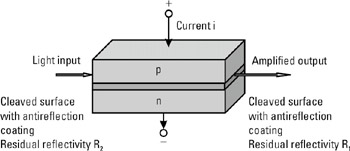
For a semiconductor of length L, with input and output reflectivities at each extremity, R 1 and R 2, respectively, and...