DWDM Fundamentals, Components, and Applications

This leading-edge resource provides comprehensive, up-to-date coverage of the principles, technologies, standards, and applications of dense wavelength division multiplexing (DWDM).
 TABLE OF CONTENTS
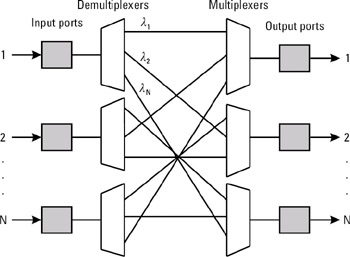
 In a node with input ports (1, 2, 3, i, N) and output ports (1, 2, 3, ,j, M), passive components allowing a wavelength selective cross-connection from N input ports to M outputs can be utilized. These components can connect any input i to any output j at a given wavelength ? ij [114-117].
The cross-connection can be made with WDM demultipler/multiplexers utilized in a back-to-back configuration as shown in Figure 6.16. In such a node it is possible to interchange wavelengths between any input and any output fibers. For instance, with ? N input port 1 is connected to output port N. As well with the same wavelength ? N the input port N can be connected to the output port 1 without collision. The optical path is determined uniquely by its input port and by its wavelength: A signal arriving on input i, carried on wavelength ? k, is routed to outport j where

See Table 6.1.
| Input/Output | 1 | 2 | 3 | 4 |
|---|---|---|---|---|
| 1 | ? 1 | ? 2 | ? 3 | ? 4 |
| 2 | ? 2 | ? 3 | ? 4 | ? 1 |
| 3 | ? 3 | ? 4 | ? 1 | ? 2 |
| 4 | ? 4 | ? 1 | ? 2 | ? 3 |
Here, the routing is...