DWDM Fundamentals, Components, and Applications

This leading-edge resource provides comprehensive, up-to-date coverage of the principles, technologies, standards, and applications of dense wavelength division multiplexing (DWDM).
 TABLE OF CONTENTS
 The OADM (Figure 6.42) is a unit that selectively removes one wavelength ? i from a multiplicity of wavelengths ? 1, ? 2, ? i, ? N multiplexed on an incoming fiber, bypasses all other wavelengths, and adds the same wavelength generally with another data content on the transmission fiber.
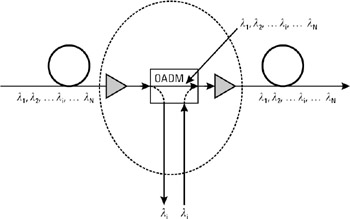
More generally, the OADM can be defined as a component that:
Demultiplexes some wavelengths from an incoming fiber and drops them locally with or without optoelectronic conversion;
Bypasses the other wavelengths arriving from the incoming fiber to an outgoing fiber;
Adds wavelengths from local subscribers on the outgoing fiber through a wavelength division multiplexer or a combiner;
Demultiplexing and multiplexing of the bypassed wavelengths with the dropped wavelengths and/or with the added wavelengths is often necessary (Figure 6.43).
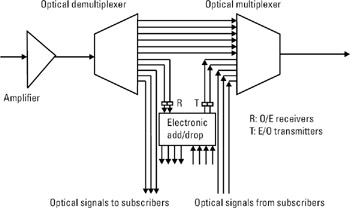
The OADM is either dynamically wavelength-selectable or the wavelength is fixed.
Of course, the most general OXC also includes similar functions and many of the enabling-technologies for OADM and OXC are equivalent. They will not be explained again when unnecessary.
These technologies take advantage of dielectric multilayer coatings, bulk-type or AWG devices, BGF, grating coupled waveguides, MZ, FP, and other interferometric devices.
The first OADM prototypes were designed in approximately 1980, but the early commercial OADM networks were deployed only a few years ago. Until 2000, they were mainly used on terrestrial interexchange and submarine networks. However, they now find increasing applications in metro/access networks. They...