Many rotors, particularly many turbine rotors, are provided with thin, large diameter parts, sometimes carrying one or more row of blades. If the ratio between the outer diameter and the thickness is large, they are usually referred to as discs.
In elementary rotordynamics, the discs are considered as rigid bodies attached to the otherwise beam-like rotor. There are, however, cases in which the dynamics of the discs becomes important, and the rigid-body assumption is too rough for a detailed dynamic analysis. The simplest model for a thin rotating disc is the rotating membrane.
14.1 Rotating Membranes
A membrane is a very thin two-dimensional object, so thin that its bending stiffness is vanishingly small and relies to in-plane stretching to maintain its shape. In a rotating membrane, the in-plane stretching is supplied by the centrifugal field. The dynamics of rotating membranes was studied by Southwell and Lamb in 1921 [6].
Consider a circular membrane with constant thickness rotating about its axis (Figure 14.1). The dynamic equilibrium equation for displacements in axial direction of the element of area located in the position (r, ?)is
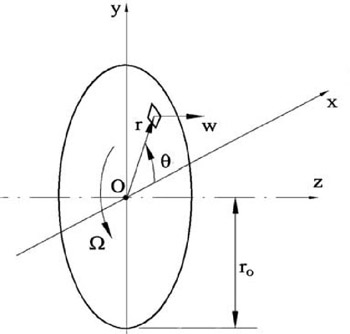 Figure 14.1: Rotating membrane. Sketch and reference frames
 where the radial and circumferential stresses ? r and ? c are functions of the radius only.
By introducing the nondimensional radial coordinate
Equation (A.53) yields
The solution of Equation (14.2) is of the type
where m is an integer.
By introducing the Solution (14.3) into Equation (14.2), the latter yields
The circumferential and radial stresses...
Copyright Springer Science+Business Media, Inc. 2005 under license agreement with Books24x7

 TABLE OF CONTENTS