Chapter List
- Chapter 2: Jeffcott Rotor
- Chapter 3: Model with Four Degrees of Freedom Gyroscopic Effect
- Chapter 4: Discrete Multi-Degrees-of-Freedom Rotors
- Chapter 5: Continuous Systems Transmission Shafts
- Chapter 6: Anisotropy of Rotors or Supports
- Chapter 7: Torsional and Axial Dynamics
- Chapter 8: Rotor-Bearings Interaction
The simplest model that can be used to study the flexural behavior of rotors consists of a point mass attached to a massless shaft. As its dynamic behavior was deeply studied in a paper published by Jeffcott in 1919 [16], it is often referred to as Jeffcott rotor; however, this attribution is incorrect as August F ppl in 1895 published a paper [13] in which its behavior is correctly analyzed (he referred to it as De Laval rotor) and Stodola [15] and Belluzzo [14] described it in their books on turbomachinery of the first years of the twentieth century.
Although the Jeffcott rotor model is an oversimplification of real-world rotors, it retains some basic characteristics and allows us to gain a qualitative insight into important phenomena typical of rotordynamics, while being much simpler than more realistic models.
2.1 Undamped Jeffcott Rotor
The three schemes sketched in Figure 2.1(a)-(c) yield the same results, as long as the system is
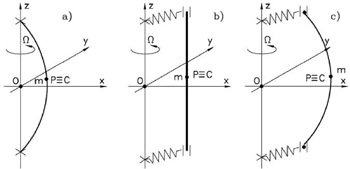 Figure 2.1: Perfectly balanced Jeffcott rotors. In (a), the rotor consists of a point mass on a flexible shaft running on stiff bearings. In (b), the shaft is stiff while the bearings...
Copyright Springer Science+Business Media, Inc. 2005 under license agreement with Books24x7

 TABLE OF CONTENTS