EIT Mechanical Review: For the Discipline Specific Fundamentals of Engineering Exam, Second Edition
When the temperature of a metal is increased most metals expand. If a member is constrained from elongating, it will be subject to strain. Since stress and strain are proportional, a strain will result in a stress, or will be evidence of a stress. The stress in a constrained member is calculated as if the member is allowed to expand and then is physically compressed the amount of the expansion.
Stress = E ?
The thermal expansion, or compression, of a member is determined by multiplying the thermal coefficient of expansion by the temperature differential. The thermal coefficient of expansion for steel is-- ? = 11.7 10 -6 m/(m C). In most cases it will simplify the calculations if strain due to stress and the strain due to temperature are calculated separately and are then added algebraically to obtain the net or final result. This can best be illustrated by means of examples.
Q:
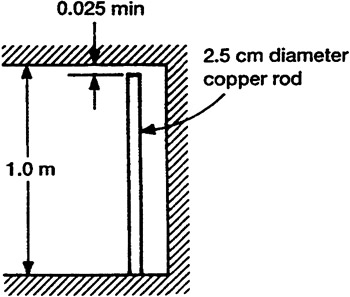
A one-meter-long copper bar having a circular cross section 2.5 cm in diameter is arranged as shown in Fig. 6-1 with a 0.025 mm. gap between its end and a rigid wall at room temperature. If the temperature increases 35 C, find the stress in the rod. Assume the coefficient of thermal expansion, a, for copper is 16.7 10 -6 m/(m C) and its modules of elasticity is 1.2 10 11 Pa..
![]()
Figure 6-1
Answers
Q:
The unrestrained increase in length due to the increase in...