EIT Mechanical Review: For the Discipline Specific Fundamentals of Engineering Exam, Second Edition

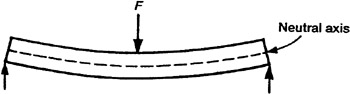
A loaded beam will strain in some fashion. When it does, it flexes and the longitudinal fibers are placed in tension or compression every place except at the neutral axis. The effect of flexure on a simple beam is shown in Fig.6-17. If the beam were made of two parallel pieces, originally of the same length which were placed in contact, but not fixed to one another, the ends of the top member would overlap the ends of the bottom member as shown in Fig. 6-18. The bottom-most fibers of the top member would strain in tension and elongate. The uppermost fibers of the bottom member would strain in compression and reduce in length. If the two members were joined together in such a manner that the differential strain were prevented, there would be a definite longitudinal shearing stress at the junction, the neutral axis, of the beam shown in Fig. 6-18.
The longitudinal shear stress is related to the transverse (vertical in this case) shear stress by the relationship- S s = VQ /(I t) Pa or shear flow = VQ/I N/m V = vertical shear load at the point being considered.
Q = ?fy dA = yA where y equals the distance from the neutral axis of the beam to the neutral axis of area A and A equals the area of the section above the plane at which the shear stress acts.
I = transverse moment...