Electric Motor Handbook

Chapter 2: Terminology and Definitions

N. Ghai

2.1 Types of Motor

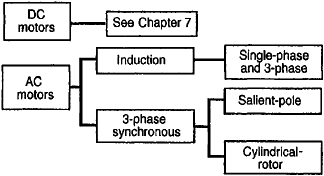
There are many ways in which electric motors may be categorized or classified. Some of these are presented below and in Fig. 2.1.


Figure 2.1: Classification of AC and DC motors.

2.1.1 AC and DC

One way of classifying electric motors is by the type of power they consume. Using this approach, we may state that all electric motors fall into one or the other of the two categories, viz., AC or DC. AC motors are those that run on alternating current or AC power, and DC motors are those that run on direct current, or DC power.

2.1.2 Synchronous and induction

Alternating current motors again fall into two distinct categories, synchronous or induction. Synchronous motors run at a fixed speed, irrespective of the load they carry. Their speed of operation is given by the relationship


where f is the system frequency in Hz and P is the number of poles for which the stator is wound. The speed given by the above relationship is called the synchronous speed, and hence the name synchronous motor. The induction motor, on the other hand, runs very close to but less than the synchronous speed. The difference between the synchronous speed and the actual speed is called the slip speed. The slip speed of any induction motor is a function of its design and of desired performance. Further, for a given motor, the slip speed and the running speed vary with the load. The running...

UNLIMITED FREE
ACCESS
TO THE WORLD'S BEST IDEAS

SUBMIT
Already a GlobalSpec user? Log in.

This is embarrasing...

An error occurred while processing the form. Please try again in a few minutes.

Customize Your GlobalSpec Experience

Category: Brushless Motors
Finish!
Privacy Policy

This is embarrasing...

An error occurred while processing the form. Please try again in a few minutes.