Electronic Devices and Amplifier Circuits
Appendix C: The Substitution, Reduction, and Miller's Theorems

This appendix discusses three additional theorems that are especially useful in the simplification of circuits containing dependent sources. In our previous studies [1] we discussed the superposition principle and Thevenin's and Norton's theorems.

C.1 The Substitution Theorem

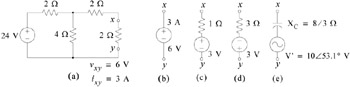
The substitution theorem states that if the voltage across a branch with nodes x and y of a network is v xy and the current through this branch is i xy, a different branch may be substituted in its place in the network provided that the voltage across the substitute branch is also v xy and the current through it is also i xy. The most common use of this theorem is to replace an impedance by a voltage or current source, or vice versa. The substitution theorem can best illustrated with the simple circuit and the substitute branches shown in Figure C.1.


Figure C.1: Illustration of the substitution theorem

For the simple resistor circuit of Figure C.1(a) we find by series-parallel resistance combinations that v xy = 6 V and i xy = 3 A. According to the substitution theorem, the 2 ? resistor across terminals x and y can be replaced with a source with a 6 V source as shown in Figure C.1(b) and the rest of the network will be unaffected. The current in the branch will be 3 A as before.

Other substitutions are possible also. For instance, the substitute branch may consist of a...

UNLIMITED FREE
ACCESS
TO THE WORLD'S BEST IDEAS

SUBMIT
Already a GlobalSpec user? Log in.

This is embarrasing...

An error occurred while processing the form. Please try again in a few minutes.

Customize Your GlobalSpec Experience

Category: Electronic Bridges
Finish!
Privacy Policy

This is embarrasing...

An error occurred while processing the form. Please try again in a few minutes.