Electronic Devices and Amplifier Circuits
This chapter begins with a discussion of Field Effect Transistors (FETs), characteristics, and applications. Other PNPN devices, the four-layer diode, the silicon controlled rectifier (SCR), the silicon controlled switch (SCS), and the triac are introduced with some of their applications. The chapter includes also a brief discussion on unijunction transistors, and diacs.
The Field-Effect Transistor (FET) is another semiconductor device. The Junction FET (JFET) is the earlier type and the Metal Oxide Semiconductor FET (MOSFET) is now the most popular type. In this section we will discuss the JFET and we will discuss the MOSFET in the next section.
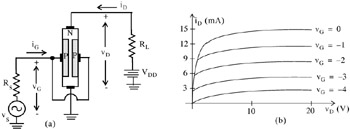
Figure 4.1(a) shows the basic JFET amplifier configuration and the output volt-ampere characteristics are shown in Fig. 4.1(b). These characteristics are similar to those for the junction transistor except that the parameter for the family is the input voltage rather than the input current. Like the old vacuum triode, the FET is a voltage-controlled device.
The lower terminal in the N material is called the source, and the upper terminal is called the drain; the two regions of P material, which are usually connected together externally, are called gates. P-N junctions exist between the P and N materials, and in normal operation the voltage applied to the gates biases these junctions in the reverse direction. A potential barrier exists across the junctions, and the electrons carrying the...