Engineering and Technology Management Tools and Applications

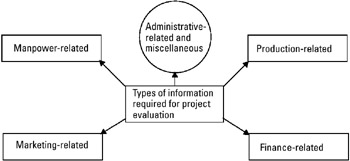
Usually, various types of information are needed to evaluate a project. Figure 4.1 presents five main categories of such information [3].
Tables 4.1 4.5 present important subelements of required marketingrelated, production-related, manpower-related, finance-related, and administrative-related and miscellaneous information, respectively. It is to be noted that these subelements may vary from one project to another.
| Number | Subelement |
|---|---|
| 1 | Acceptance by consumer |
| 2 | Potential market and its size |
| 3 | Impact on consumer safety |
| 4 | Probable market share |
| 5 | Possibility for spin-off |
| 6 | Impact on existing product line |
| 7 | Ability to control quality |
| 8 | Time until acquiring market share |
| 9 | Output's estimated life |
| Number | Subelement |
|---|---|
| 1 | Availability of raw materials |
| 2 | Energy needs |
| 3 | Equipment and facility requirements |
| 4 | Process safety |
| 5 | Degree and length of disruption during installation |
| 6 | Effect on waste |
| 7 | Compatibility with current technological know-how |
| 8 | Change in quality of output and quality-control procedures |
| 9 | Required development time |
| 10 | Time until ready to install |
| 11 | Impact on suppliers |
| 12 | Other areas of applications of technology |
| 13 | Change in raw material usage, time to produce a unit, and cost to produce a unit |
| Number | Subelement |
|---|---|
| 1 | Availability of required skilled labor |
| 2 | Skill and training requirements |
| 3 | Impact on current work conditions |
| 4 | Change in work force size |