Introduction
ABS resins are thermoplastic resins composed of three kinds of monomers acrylonitrile, butadiene, and styrene. They were created as resins with the harmony of hardness and softness by improving the brittleness, which is the disadvantage of polystyrenes, through addition of a rubber component while maintaining hardness and fluidity, which are the advantages of polystyrenes. See Fig. 6.1.
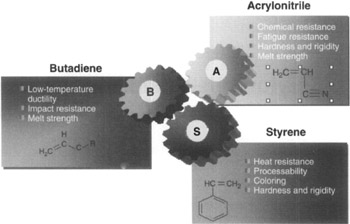 Figure 6.1: ABS terpolymer and its functionality.
 ABS resins were developed in the form of graft-type ABS by several manufacturing companies, including Borg-Warner (presently, General Electric), Monsanto, and JSR, and introduction of blend-type ABS resins by the U. S. Rubber Industry of America in 1948. The preparation of ABS by graft polymerization was repeatedly developed after its introduction in 1956, and now it is used as one of the major methods for preparing rubber-toughened thermoplastic resins.
As is well known, ABS resins are one type of excellent resin having all the desirable properties, including impact resistance, processability, gloss property, good mechanical properties, and high heat distortion temperature. Therefore, ABS resins have been used in very broad fields of application and particularly in many aspects of daily life. At present, the amount used has gradually increased.
However, in practice, since it is also difficult to prepare ABS resins with various harmonized properties, many studies have been made during the past 50 years and more, and currently various studies are underway with the aim to improve both the properties and the manufacturing processes in the...


 TABLE OF CONTENTS