Environmental Stress Screening: Its Quantification, Optimization, and Management
Chapter 7: Physical Quantification of ESS by Thermal Cycling

7.1 THE ARRHENIUS MODEL AND ITS PITFALLS

7.1.1 THE ARRHENIUS MODEL AND THE CORRESPONDING ACCELERATION FACTOR

Elevated temperature is the most commonly used environmental stress for both accelerated life testing and stress screening of electronic devices. As discussed in Chapter 4 thermal cycling and random vibration are the most effective screening environments in ESS. The effect of elevated temperature upon electronic devices is generally modelled using the Arrhenius reaction rate equation. This equation is

where

V =

reaction rate measured in moles/(volume time),

A =

proportionality constant, or the so-called frequency factor ,

E A =

activation energy measured in electron-volts, eV,

T* =

absolute temperature in K,

and

K =

Boltzmann's constant = 8.623 10 5 eV/ K.

Equation (7.1) expresses the time rate of device degradation as a function of operating temperature. The degradation is assumed to correspond to chemical or physical reactions among device constituents and contaminants. In those cases where the failure mechanism follows the Arrhenius relationship and the life distribution is exponential, the constant failure rate, ?( T*), is directly proportional to the reaction rate; thus, from Eq. (7.1)

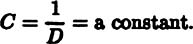
where D is a constant. Under the exponential life distribution assumption, the mean time to failure or mean life, L( T*), is given by

where

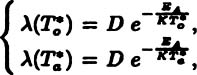
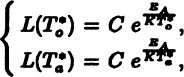
Correspondingly, the failure rates and mean lives at operational temperature T* o and at accelerated temperature T* a are given by

and

respectively. The acceleration...

UNLIMITED FREE
ACCESS
TO THE WORLD'S BEST IDEAS

SUBMIT
Already a GlobalSpec user? Log in.

This is embarrasing...

An error occurred while processing the form. Please try again in a few minutes.

Customize Your GlobalSpec Experience

Category: Temperature Forcing Systems
Finish!
Privacy Policy

This is embarrasing...

An error occurred while processing the form. Please try again in a few minutes.