Environmental Stress Screening: Its Quantification, Optimization, and Management
For some types of devices, the simultaneous application of multiple stresses seems to provide extreme accelerations with typical stress levels or moderate accelerations with very modest stresses [1]. The question is how to quantify the aging acceleration that results from the simultaneous application of multiple stresses and how to determine whether there are interactions among these stresses or not.
Nachlas et al [1] proposed a general model to represent component aging, which has an additive form in the absence of any interaction and has additional polynomial terms in the presence of interactions. A factorial experimental design technique can be used to test the following two hypotheses:
H 0: The accelerations due to simultaneously applied stresses act independently,
versus
H 1: There is a synergistic effect (interaction) associated with the simultaneously applied stresses.
The life distribution of each of the components studied is assumed to be the two-parameter Weibull with shape parameter less than one (1) or with a decreasing failure rate; i.e.,
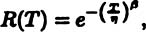
The cdf and the reliability function of this life distribution are given by
and
respectively. Let

Then, F( T) and R( T) can be simplified as
and
Denote the component's reliability function, under multiple simultaneously applied stresses, by R a( T) and assume that
where
Obviously, this acceleration factor, A, is a function of the...