Essentials of RF and Microwave Grounding
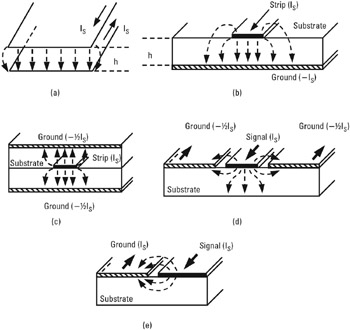
By far the most commonly used transmission lines are the planar types, some of which are shown in Figure 3.22. They can be constructed precisely using low-cost printed circuit board materials and processes. A number of these open, multiconductor transmission lines comprise a solid dielectric substrate having one or two layers of metallization, with the signal and ground currents flowing on separate conductors. The parallel-plate waveguide (PPWG) in Figure 3.22(a) propagates the TEM mode, and so does the stripline [Figure 3.22(c)]. For microstrip [Figure 3.22(b)], coplanar waveguide (CPW) in Figure 3.22(d) and slot line [Figure 3.22(e)], the electromagnetic field exists in two different dielectrics, the substrate and air, so the dominant mode is quasi-TEM. This mode has a 0-Hz cutoff frequency, and for most purposes is very much like the TEM mode, but its characteristic impedance and propagation constant slowly change with increasing frequency.
In general, for a given conductor separation (or substrate thickness) h, the characteristic impedance for PPWG, microstrip, and stripline decreases with increasing line width and increasing dielectric constant [9, 10]. For CPW the characteristic impedance increases as the gap between the conductors or the center conductor (signal) line width decreases. Because both the signal and ground currents of CPW and slot line flow on the same layer, the...