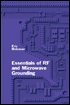
Essentials of RF and Microwave Grounding
3.7: RF Short and Open Circuits

3.7 RF Short and Open Circuits

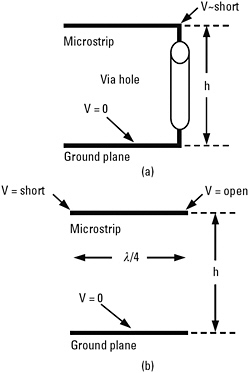
As frequency increases, particularly into the millimeter-wave bands, the reactance to ground of a DC short circuit such as a via hole becomes unacceptable. For example, a 0.1-nH via hole has 22 ohms of reactance at 35 GHz. As an alternative to a DC short to ground, we can use an RF short circuit, a quarter-wavelength transmission line terminated in an open circuit. Figure 3.33 shows both DC and RF short circuit terminations realized with microstrip. Unlike the ideal DC short circuit, which is a zero-ohm termination connecting the signal and ground conductors of a transmission line, a RF short circuit is a noncontacting termination. The transmission line signal and ground connections are purposely left unconnected so as to form an open circuit. No current flows to the ground conductor from the signal conductor, although current is induced in the ground plane. The incident and reflected voltage waves create a standing wave for which the voltage one-quarter wavelength back from the open circuit is zero volts as shown in Figure 3.34. From (3.4), the input impedance of a transmission line terminated in an open circuit is given by


Figure 3.33: A via hole is a perfect short circuit to ground only at 0 Hz because it has physical length h, while an open-circuited line can be transformed into a perfect short circuit at any frequency.

Figure 3.34: Equivalent circuit of (a) via hole to ground, and (b) RF short from quarter-wave open-circuited...

UNLIMITED FREE
ACCESS
TO THE WORLD'S BEST IDEAS

SUBMIT
Already a GlobalSpec user? Log in.

This is embarrasing...

An error occurred while processing the form. Please try again in a few minutes.

Customize Your GlobalSpec Experience

Category: RF Couplers
Finish!
Privacy Policy

This is embarrasing...

An error occurred while processing the form. Please try again in a few minutes.