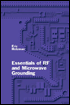
Essentials of RF and Microwave Grounding
Chapter 1: Introduction to Grounding

In this chapter, we review the fundamentals of low frequency grounding and define the following terms: ground, ground path, and grounding. We compare low frequency and high frequency circuits and describe the differences between low frequency and high frequency grounding. We conclude with a summary of radio frequency (RF) grounding problems and their impact on the performance of microwave components and subsystems.

1.1 Grounding for DC and Low-Frequency AC Circuits

The principles of low frequency grounding are well known, and they form the basis for our discussion of high frequency grounding. Figure 1.1 shows a simple circuit consisting of a voltage source that supplies electrical current to a load such as a light bulb. The electric current I S is defined in terms of positive charges moving from the positive electrode of the source to ground. Since electrons are negatively charged, they flow in the opposite direction. The source does work and transfers energy to the current I S. The current flows in metal conductors, such as wires, to the load. If the connecting wires are lossless (meaning they do not reduce the electron potential), and the load is matched properly to the source, all the current s energy is transferred to the load. The current emerges from the load at a potential of 0 volts and returns to the source along the ground path. Since charge can neither be created nor destroyed, the source and load currents must be the same. Ohm s law gives the current I

UNLIMITED FREE
ACCESS
TO THE WORLD'S BEST IDEAS

SUBMIT
Already a GlobalSpec user? Log in.

This is embarrasing...

An error occurred while processing the form. Please try again in a few minutes.

Customize Your GlobalSpec Experience

Category: Power Plugs
Finish!
Privacy Policy

This is embarrasing...

An error occurred while processing the form. Please try again in a few minutes.