Ethernet in the First Mile

For engineers struggling with the IEEE standard 802.3, this book annotates and explains the dense language of the standard document, taking particular care how to explain how the EFM dovetails with other standards.
 TABLE OF CONTENTS
 The ITU-T specifies its xDSL transceiver recommendations according to a layered reference model shown in Figure 3.2.
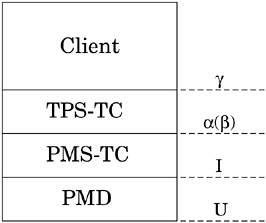
The bottom layer of the reference model is the Physical Medium Dependent (PMD) layer, which contains the flavor-specific physical functions. The PMD transmits and receives a stream of symbols, suitably designed to carry information over the medium with a sufficiently low probability of error. Different xDSL flavors use different modulation techniques and different spectra to provide specific services over specific types of loops in an optimal way. The PMD layer is terminated by the U-interface at the bottom (i.e., the electrical interface with the medium) and by the I-interface at the top (a purely functional interface).
The Physical Medium Specific Transmission Convergence (PMS-TC) layer is the layer above the PMD layer. The PMS-TC transmits and receives information encoded as bits, to be loaded onto the PMD symbols. It has no actual awareness of the physical medium, other than the bitrate that it experiences at the I-interface. It contains functions such as forward error correction, framing, and scrambling, which are designed to work well with a specific modulation technique. Therefore, the PMS-TC is flavor-specific. [7] The PMS-TC is terminated at the top by the functional ?-interface (CO side) or ?-interface (CPE side).
The PMD and PMS-TC layers have been specified for a growing number of xDSL flavors, each optimized for a certain loop reach or service mix. The...